
Long Division With Decimals Explained
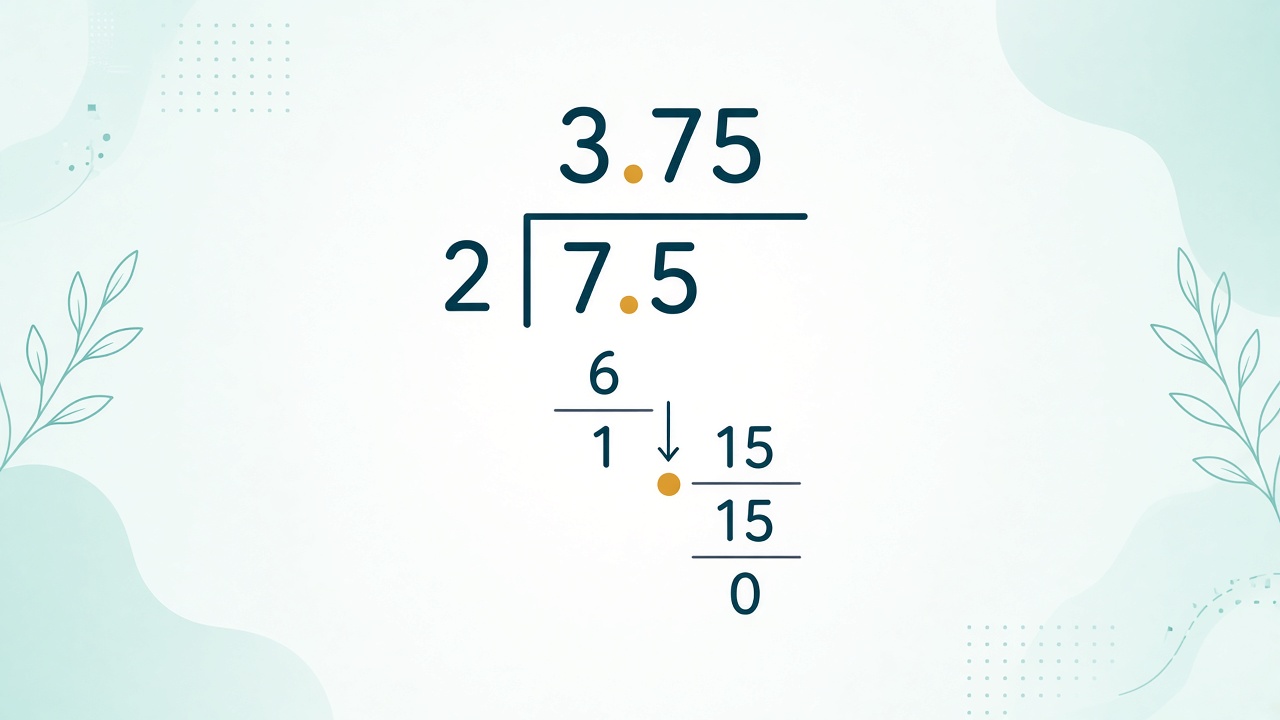
How to Do Long Division With Decimals
Long division with decimals has two cases. When the dividend has a decimal, divide as usual and carry the decimal point straight up into the quotient above its position. When the divisor has a decimal, multiply both numbers by the same power of 10 to make the divisor whole, then divide normally. Dividing 7.5 by 2 gives 3.75, and dividing 6.25 by 0.5 becomes 62.5 by 5, which is 12.5.
Decimals appear in division whenever a value is not a whole number, or when a whole-number division continues past the decimal point for an exact answer. The Long Division Calculator handles both cases and shows each step, and this guide explains the decimal rules that sit on top of the standard five-step method.
Dividing a Decimal by a Whole Number
When only the dividend has a decimal, the division works exactly like whole-number division, with one addition: place the decimal point in the quotient directly above the decimal point in the dividend. The digits are divided in the usual order, and the decimal point carries straight up.
To divide 7.5 by 2, the divisor 2 fits into 7 three times with 1 left, then into 15 (after bringing down the 5) seven times with 1 left. Carrying the decimal point up and continuing past it with a zero gives 3.75. Aligning the quotient’s decimal point with the dividend’s is the single rule that separates this from whole-number division.
Dividing by a Decimal
When the divisor has a decimal, make it a whole number first. Move the decimal point in the divisor to the right until it is whole, then move the decimal point in the dividend the same number of places. This multiplies both numbers by the same power of 10, which leaves the quotient unchanged.
To divide 6.25 by 0.5, move the decimal one place in each number: 0.5 becomes 5, and 6.25 becomes 62.5. The division 62.5 ÷ 5 = 12.5 gives the answer. Shifting both numbers works because division is a ratio, so scaling the top and bottom by the same factor does not change the result, the same reason 6 ÷ 2 equals 60 ÷ 20. The Long Division Calculator with Decimals performs the shift and the division together.
Continuing a Division Past the Decimal Point
A whole-number division that leaves a remainder can continue into decimals for an exact answer. After the whole-number quotient, add a decimal point, bring down a zero to the remainder, and keep dividing. This turns a remainder into a decimal, covered alongside remainders in the guide on long division with remainders.
To divide 13 by 4, the whole-number result is 3 with a remainder of 1. Adding a decimal point and bringing down a zero makes 10, and 4 fits into 10 twice with 2 left; bringing down another zero makes 20, and 4 fits five times exactly. The answer is 3.25, a terminating decimal, because the division reached a remainder of zero.
Terminating and Repeating Decimals
A division produces one of two decimal types. A terminating decimal ends when the remainder reaches zero, as in 13 ÷ 4 = 3.25. A repeating decimal never reaches zero, because the same remainder returns and a digit or block of digits repeats forever.
Dividing 1 by 3 gives 0.333 repeating, since every step leaves a remainder of 1 and brings down another zero. Dividing 1 by 7 gives 0.142857 repeating, a six-digit block that cycles. Recognizing a repeating remainder tells you to stop and mark the repeat rather than divide forever, and the calculator marks the repeating digits automatically.
Key Takeaways
- For a decimal in the dividend, carry the decimal point straight up into the quotient and divide as usual.
- For a decimal in the divisor, shift the decimal in both numbers by the same number of places to make the divisor whole.
- Shifting both numbers by the same power of 10 does not change the quotient, because division is a ratio.
- Continue a whole-number division past the decimal point by bringing down zeros for an exact answer.
- A division either terminates when the remainder hits zero or repeats when the same remainder returns.
Frequently Asked Questions
How do you do long division with decimals?
When the dividend has a decimal, divide as usual and carry the decimal point straight up into the quotient above its position. When the divisor has a decimal, multiply both the divisor and the dividend by the same power of 10 to make the divisor a whole number, then divide normally. The quotient is unchanged by that shift.
How do you divide a decimal by a whole number?
Divide a decimal by a whole number the same way as whole-number division, and place the decimal point in the quotient directly above the decimal point in the dividend. To divide 7.5 by 2, divide as normal and carry the decimal up, giving 3.75. Add zeros after the decimal if the division continues.
How do you divide by a decimal?
To divide by a decimal, move the decimal point in the divisor to the right until it is a whole number, then move the decimal point in the dividend the same number of places. Dividing 6.25 by 0.5 becomes 62.5 by 5, which equals 12.5. The answer stays the same, because both numbers are multiplied by the same power of 10.
What is a repeating decimal in long division?
A repeating decimal appears when a division never reaches a remainder of zero and the same remainder returns, so a digit or block of digits repeats forever. Dividing 1 by 3 gives 0.333 repeating, because each step leaves a remainder of 1. A terminating decimal, by contrast, ends when the remainder reaches zero.
Why can you move the decimal point in both numbers when dividing?
Moving the decimal point the same number of places in both the divisor and the dividend multiplies both by the same power of 10, which does not change the quotient. Division is a ratio, so scaling the top and bottom by the same amount leaves the result unchanged, the same reason 6 divided by 2 equals 60 divided by 20.
Conclusion
Long division with decimals adds two rules to the standard method: carry the decimal point straight up for a decimal dividend, and shift both numbers to make a decimal divisor whole. Continue past the decimal point with zeros for an exact answer, and mark a repeating block when the same remainder returns. Work through any decimal division with the Long Division Calculator.
Ready to run the numbers? Use the Long Division Calculator.